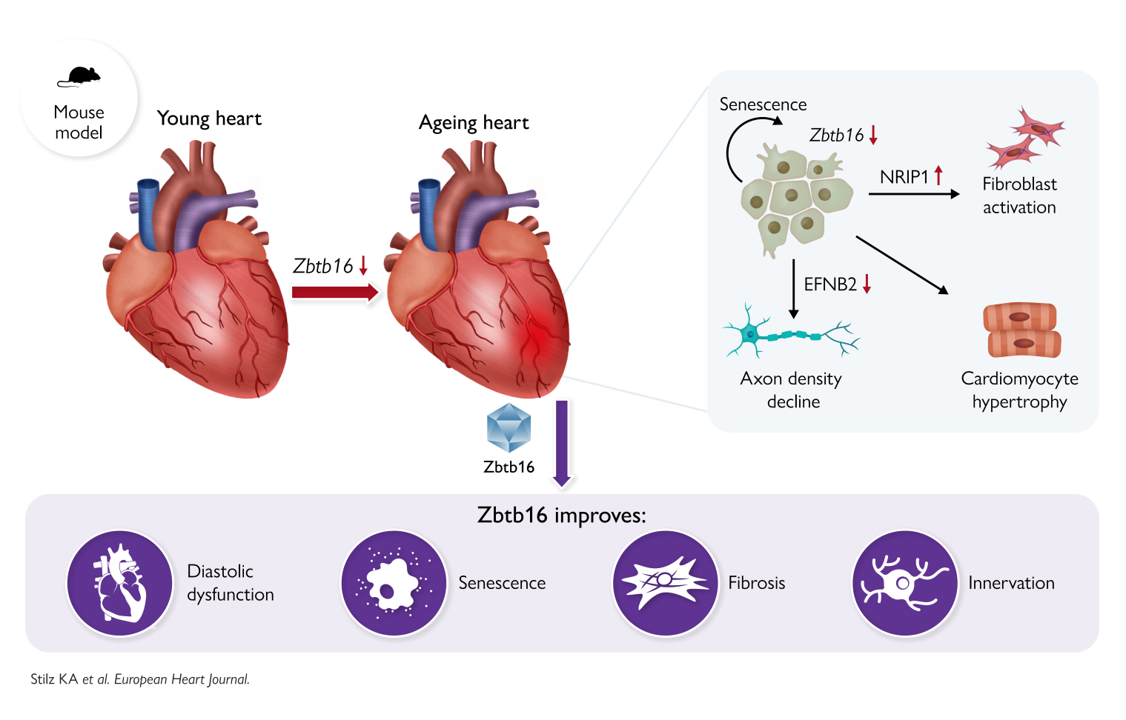
In Stilz et al.'s recent European Heart Journal paper, researchers uncover endothelial ZBTB16 as a critical molecular regulator of cardiac aging. Aging increases cardiovascular risk through progressive diastolic dysfunction and fibrosis. A decline in vascular function contributes to age-related cardiac dysfunction, but the molecular mechanism underlying vascular aging was unclear, until now. The team shows that the expression of endothelial ZBTB16, a transcription factor, drops with age in both mice and humans, disrupting angiogenesis, boosting pro-fibrotic paracrine signals to fibroblasts, and impairing sympathetic innervation.
Using single-nucleus RNA-seq, in situ hybridization, and endothelial-specific knockouts, they demonstrate how ZBTB16 loss accelerates premature cardiac aging phenotypes like hypertrophy and diastolic impairment. Excitingly, overexpressing ZBTB16 in aged mice reversed fibrosis, restored systolic strain, and improved diastolic function—highlighting its therapeutic promise.
This work positions the endothelial niche as a master regulator of cardiac aging. ZBTB16 emerges as a prime target for preventing age-related heart failure, though safe endothelial delivery remains the next challenge.
Find the full article here: https://doi.org/10.1093/eurheartj/ehaf1063
You need to load content from hCaptcha to submit the form. Please note that doing so will share data with third-party providers.
More InformationYou need to load content from reCAPTCHA to submit the form. Please note that doing so will share data with third-party providers.
More InformationYou need to load content from reCAPTCHA to submit the form. Please note that doing so will share data with third-party providers.
More InformationYou need to load content from reCAPTCHA to submit the form. Please note that doing so will share data with third-party providers.
More InformationYou need to load content from Turnstile to submit the form. Please note that doing so will share data with third-party providers.
More Information