How do cells hold important RNA molecules in reserve and release them at the right moment?
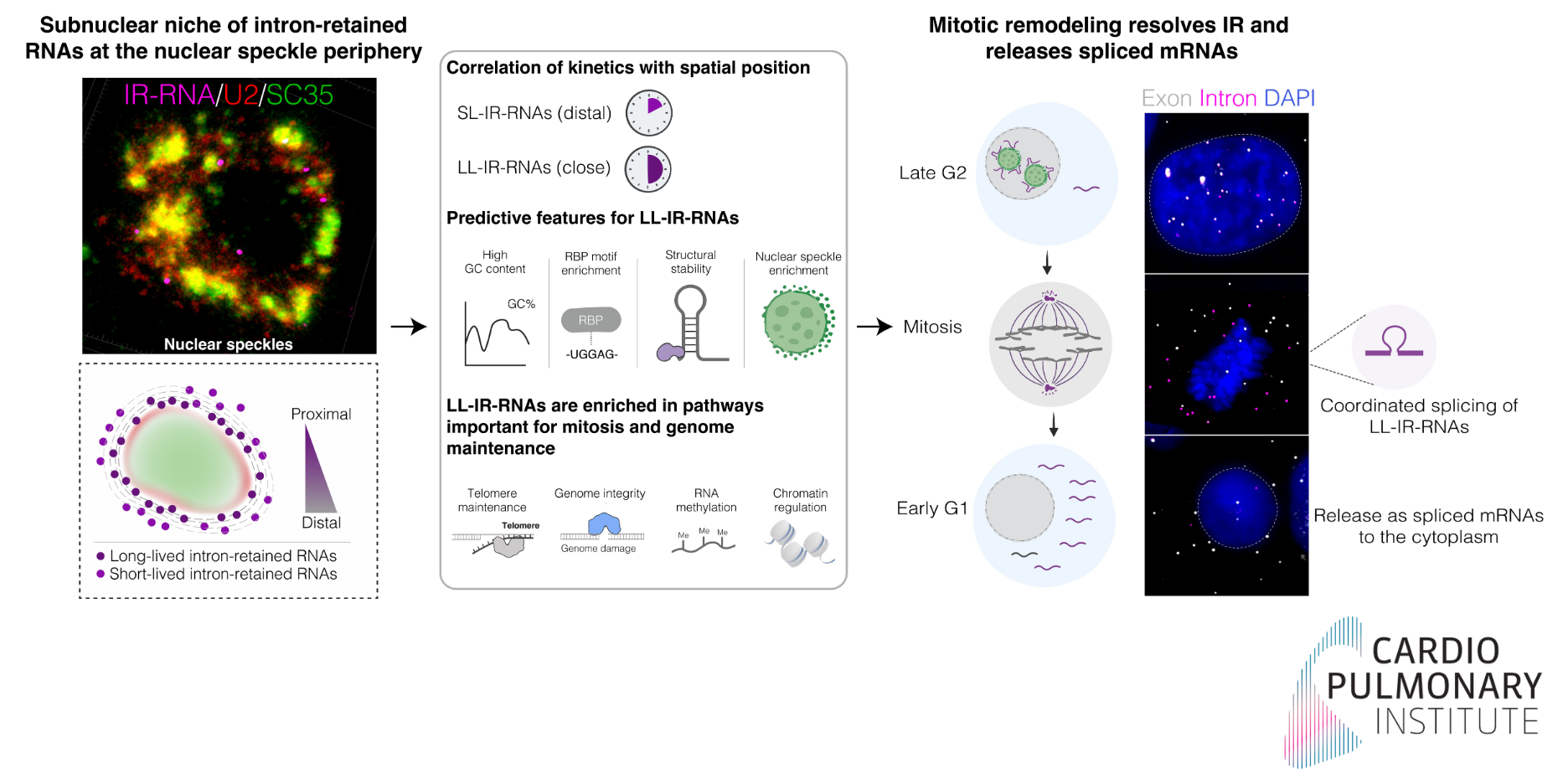
A new study published in Nature Cell Biology characterizes a spatially and temporally regulated compartment of intron-retained RNAs at the periphery of nuclear speckles.
Combining compartment-resolved RNA sequencing, single-molecule and super-resolution imaging, and sequence-based deep learning, the researchers identified RNAs with long-lived retained introns that persist in the nucleus for hours. Many of these transcripts encode key regulators of genome maintenance, DNA repair, telomere maintenance, and mitosis.
When cells enter mitosis, these retained introns undergo a coordinated, kinase-dependent removal, allowing mature transcripts to accumulate in the cytoplasm of early G1 daughter cells.
These findings connect intronic sequence features, subnuclear organization, and mitotic remodelling to the temporal control of RNA processing and localization, suggesting a potential mechanism for coordinating RNA availability across cell division.
📄 Read the full paper HERE.
You need to load content from hCaptcha to submit the form. Please note that doing so will share data with third-party providers.
More InformationYou need to load content from reCAPTCHA to submit the form. Please note that doing so will share data with third-party providers.
More InformationYou need to load content from reCAPTCHA to submit the form. Please note that doing so will share data with third-party providers.
More InformationYou need to load content from reCAPTCHA to submit the form. Please note that doing so will share data with third-party providers.
More InformationYou need to load content from Turnstile to submit the form. Please note that doing so will share data with third-party providers.
More Information