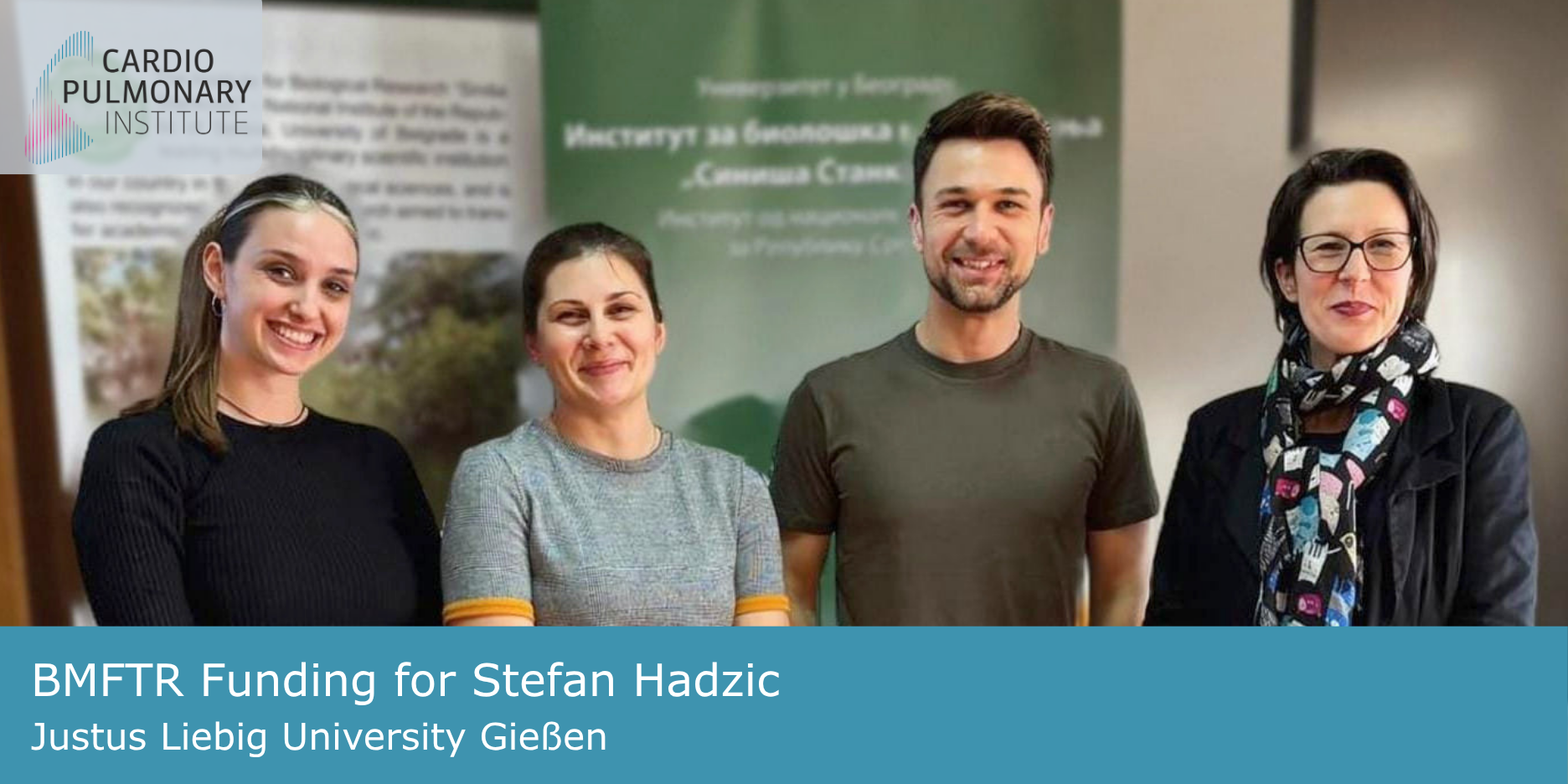
The Federal Ministry of Research, Technology and Space (BMFTR) is funding a new German–Serbian research project with more than €350,000 over three years as part of its Western Balkans 2025 initiative in the thematic area Healthy Societies. Lung researcher Dr. Stefan Hadzic from the Cardio-Pulmonary Institute (CPI) at Justus Liebig University Giessen and immunologist Dr. Dragica Micanovic from the Institute for Biological Research "Siniša Stanković" (IBISS) at the University of Belgrade will investigate whether an immune response against the lung's own post-translationally modified proteins is responsible for the progression of chronic obstructive pulmonary disease (COPD).
COPD is incurable and among the leading causes of death worldwide, with a particularly high burden in the Western Balkans, where smoking rates and air pollution exceed the European average. Current therapies relieve symptoms but cannot halt the destruction of lung tissue, and the disease often progresses even after smoking cessation. The project builds on previous findings from the CPI. In the COPD lung, oxidative and nitrosative stress produce peroxynitrite, which converts the amino acid tyrosine in proteins to 3-nitrotyrosine (3-NT). Hadzic and colleagues showed that 3-NT levels track with disease severity, that nitration impairs the lung's repair programmes, and that the susceptibility factor CEACAM6 amplifies nitration by suppressing the antioxidant enzyme heme oxygenase-1 (Wu et al., Am J Respir Crit Care Med 2023). Nitration can also create new molecular features, so-called neo-epitopes, that the immune system may recognise as foreign, sustaining inflammation long after the original exposure has ended. Testing this idea requires both disciplines. The CPI contributes its expertise in redox biology and its models of smoke-induced emphysema and pulmonary hypertension, while the Department of Immunology at IBISS brings long experience with autoimmunity. In joint pilot experiments, analyses in collaboration by Dr. Micanovic showed that enhanced nitration in relevant preclinical models triggered an early immune response in the lung, followed by more severe emphysema.
Over the next three years, the teams will map nitrated proteins in patients and preclinical models, characterise the immune responses they trigger, and develop antibodies against defined 3-NT targets for diagnosis and therapy. The long-term goal is to establish protein nitration as a druggable checkpoint in COPD and other diseases driven by protein modification. The collaboration between Giessen and Belgrade will connect both teams, and doctoral students in both countries will benefit from joint supervision that combines lung research at the CPI with immunology at IBISS.
Congratulations to Dr. Stefan Hadzic and the whole AIMCOPD-Team on receiving this funding!
You need to load content from hCaptcha to submit the form. Please note that doing so will share data with third-party providers.
More InformationYou need to load content from reCAPTCHA to submit the form. Please note that doing so will share data with third-party providers.
More InformationYou need to load content from reCAPTCHA to submit the form. Please note that doing so will share data with third-party providers.
More InformationYou need to load content from reCAPTCHA to submit the form. Please note that doing so will share data with third-party providers.
More InformationYou need to load content from Turnstile to submit the form. Please note that doing so will share data with third-party providers.
More Information