Macrophages fight lung cancer with a surprising metabolic weapon
Cancer cells are often described as masters of metabolism, rewiring biochemical pathways to fuel their growth and survival. But tumors do not act alone. They are surrounded by immune cells that can either support or suppress disease progression. Among these, tumor-associated macrophages (TAMs) are abundant in lung cancer and play key roles in shaping the tumor microenvironment. A study led by the group of Rajkumar Savai at the Cardio-Pulmonary Institute (CPI) and Institute for Lung Health (ILH), now published in Cell Metabolism, reveals that the macrophage-derived metabolite itaconate acts as a powerful brake on lung tumor growth by reprogramming both macrophages and cancer cells.
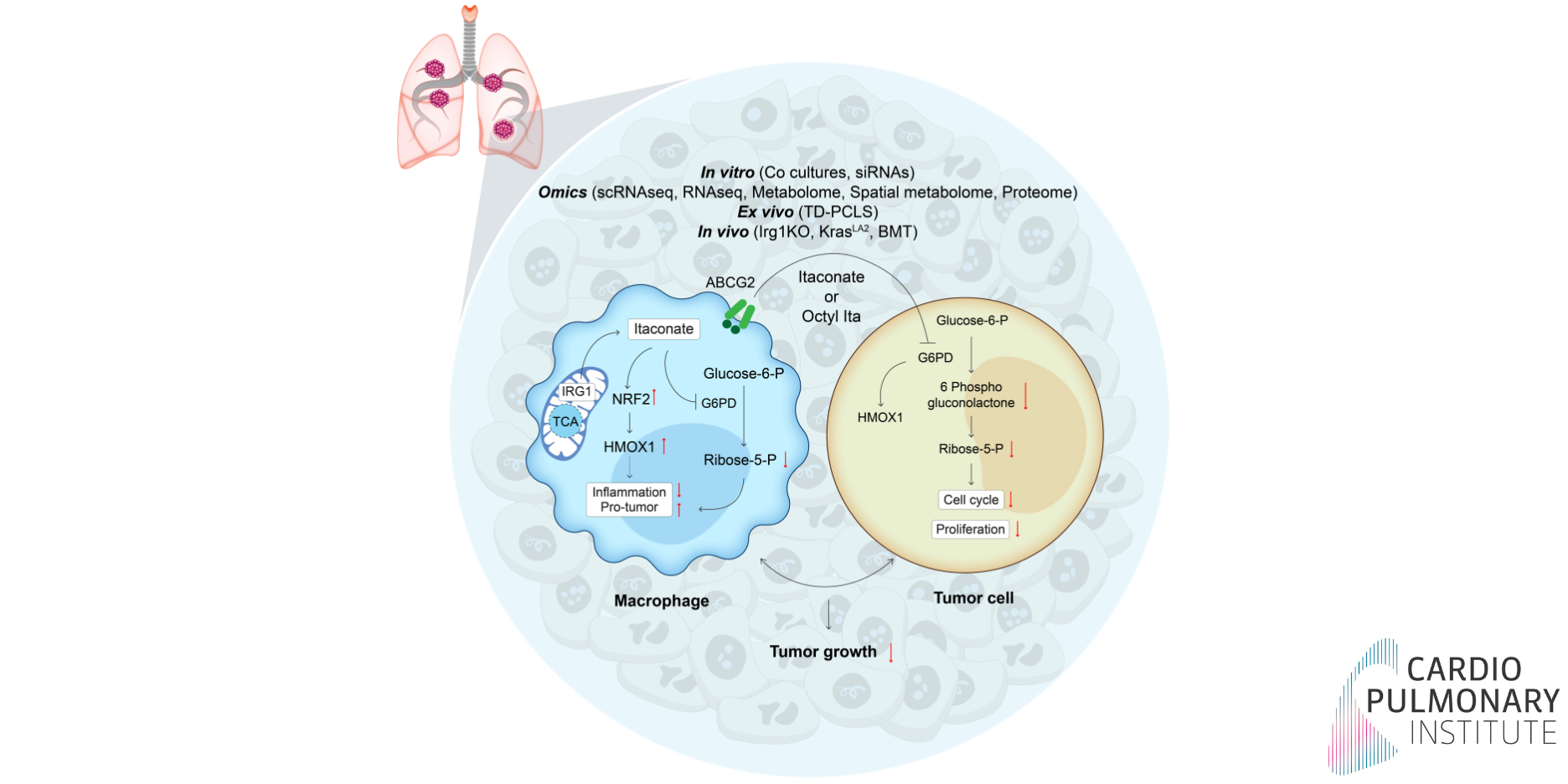
Using spatial metabolomics, the researchers showed that itaconate is markedly depleted within lung tumors compared with surrounding healthy tissue. Single-cell analyses identified macrophages as the principal source of the enzyme IRG1, which produces itaconate, in both human and mouse lung cancers. When IRG1 was genetically deleted, or when mice received IRG1-deficient bone marrow, tumors grew significantly faster, uncovering a previously unrecognized tumor-suppressive role for the IRG1–itaconate pathway. The team then uncovered the mechanism behind this effect. Integrated multi-omics analyses revealed that itaconate targets glucose-6-phosphate dehydrogenase (G6PD), the rate-limiting enzyme of the pentose phosphate pathway, a metabolic route heavily relied upon by rapidly growing cancer cells. By inhibiting G6PD activity, itaconate suppresses tumor cell metabolism while reprogramming macrophages from a pro-tumor to an anti-tumor state, creating a microenvironment less permissive to cancer growth.
"Our findings reveal that macrophages possess an intrinsic metabolic mechanism to restrain tumor progression," says Rajkumar Savai. "Rather than simply responding to cancer, these cells actively rewire tumor metabolism through itaconate and shift the balance toward anti-tumor immunity." Importantly, treatment with 4-octyl itaconate (Octyl Ita), a cell-permeable derivative of itaconate, suppressed tumor growth in cultured cancer cells, mouse models, and precision-cut human lung tumor slices. These findings suggest that enhancing the IRG1–itaconate pathway could represent a new strategy to target both cancer cells and their supportive microenvironment.
"Most cancer therapies focus on the tumor itself," notes first author Siavash Mansouri. "Our study shows that activating a naturally occurring metabolic program in macrophages can simultaneously weaken tumor metabolism and strengthen anti-tumor immunity." The work identifies the IRG1–itaconate–G6PD axis as a central regulator of tumor–immune cell interactions and highlights how immune metabolism can be harnessed to combat lung cancer.
Overall, the findings reveal an unexpected metabolic weapon used by macrophages against lung cancer and open new avenues for therapies that target both tumors and their immune microenvironment.
Find the full article here: https://doi.org/10.1016/j.cmet.2026.05.005
You need to load content from hCaptcha to submit the form. Please note that doing so will share data with third-party providers.
More InformationYou need to load content from reCAPTCHA to submit the form. Please note that doing so will share data with third-party providers.
More InformationYou need to load content from reCAPTCHA to submit the form. Please note that doing so will share data with third-party providers.
More InformationYou need to load content from reCAPTCHA to submit the form. Please note that doing so will share data with third-party providers.
More InformationYou need to load content from Turnstile to submit the form. Please note that doing so will share data with third-party providers.
More Information