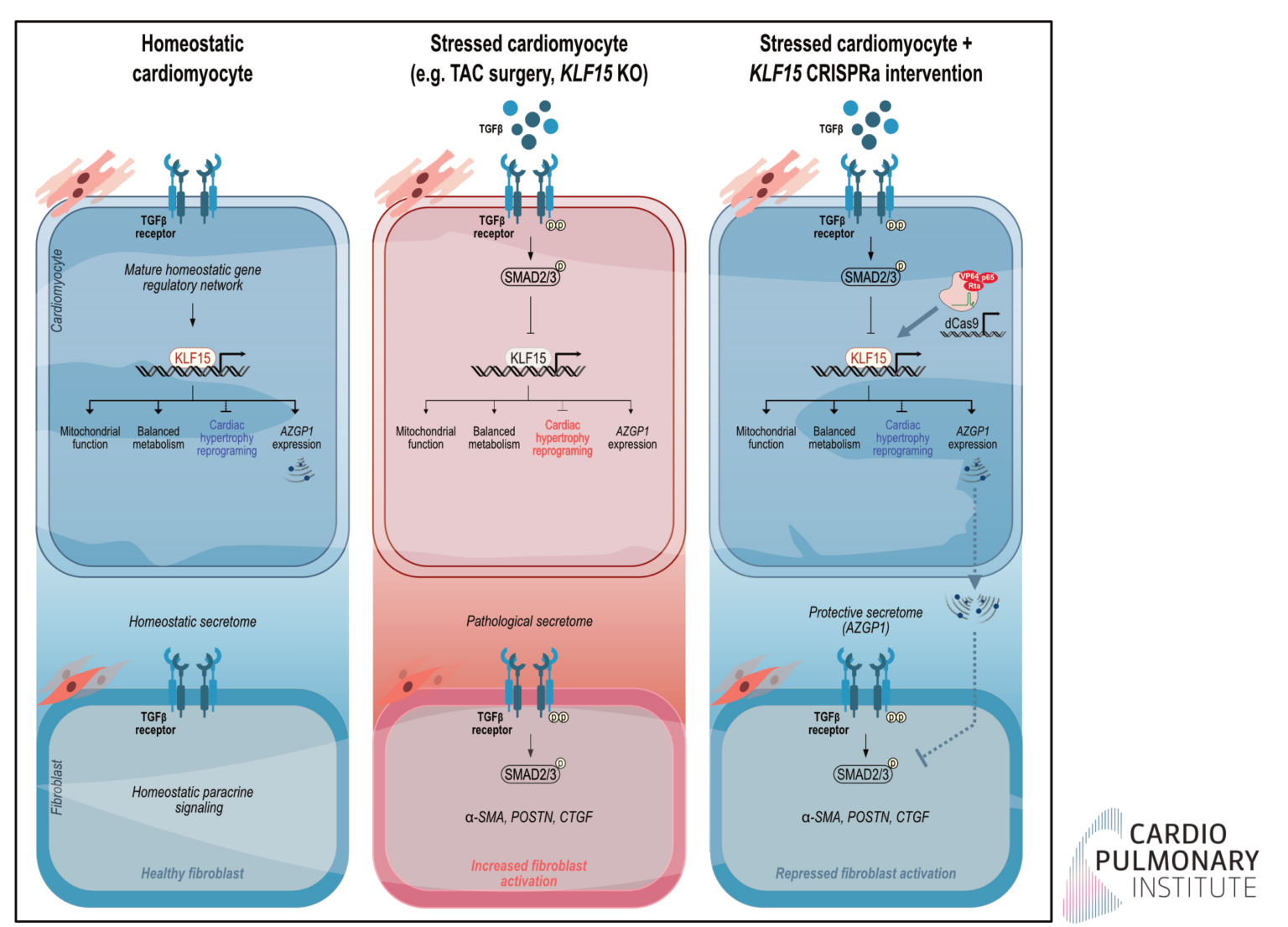
Heart failure is driven by maladaptive gene programs that lead to progressive pathological cardiac remodeling; however, targeted approaches to reset these transcriptional networks remain lacking, particularly in non-genetic forms of heart failure with multifactorial causes. Using network-based analysis of single-cell cardiac transcriptomes to infer transcription factor activity in vivo, we identify loss of KLF15 activity as a central driver of pathological remodeling in stressed cardiomyocytes.
Using a CRISPRa-based strategy, we restored endogenous KLF15 expression and effectively reprogrammed diseased cardiomyocytes toward a healthy state. This intervention suppressed pathological gene activation, normalized metabolic function and cardiomyocyte structure in a cell-autonomous manner, and reduced fibrosis in a non-cell-autonomous manner through cardiomyocyte–fibroblast crosstalk mediated by alpha-2-glycoprotein 1, zinc-binding (AZGP1). Thus, CRISPRa transforms cardiomyocytes into engines of protective signaling. Mechanistically, we uncovered a TGF-β-KLF15-AZGP1 axis that links stress signaling to transcriptional and intercellular remodeling in human cells. To enable clinical translation, we engineered an AAV9-compatible CRISPRa module for targeted gene activation, validated in cardiomyocytes and human heart tissue.
Together, our findings establish CRISPRa-mediated transcriptional normalization as a pipeline and a promising therapeutic strategy for non-genetic heart failure, shifting the paradigm from gene replacement to precise reactivation of endogenous protective programs. This approach provides a blueprint for targeting additional non-hereditary pathologies and overcomes key limitations of traditional overexpression strategies while preserving the native genomic context.
Find the full article here: https://doi.org/10.1038/s41392-026-02593-9
You need to load content from hCaptcha to submit the form. Please note that doing so will share data with third-party providers.
More InformationYou need to load content from reCAPTCHA to submit the form. Please note that doing so will share data with third-party providers.
More InformationYou need to load content from reCAPTCHA to submit the form. Please note that doing so will share data with third-party providers.
More InformationYou need to load content from reCAPTCHA to submit the form. Please note that doing so will share data with third-party providers.
More InformationYou need to load content from Turnstile to submit the form. Please note that doing so will share data with third-party providers.
More Information