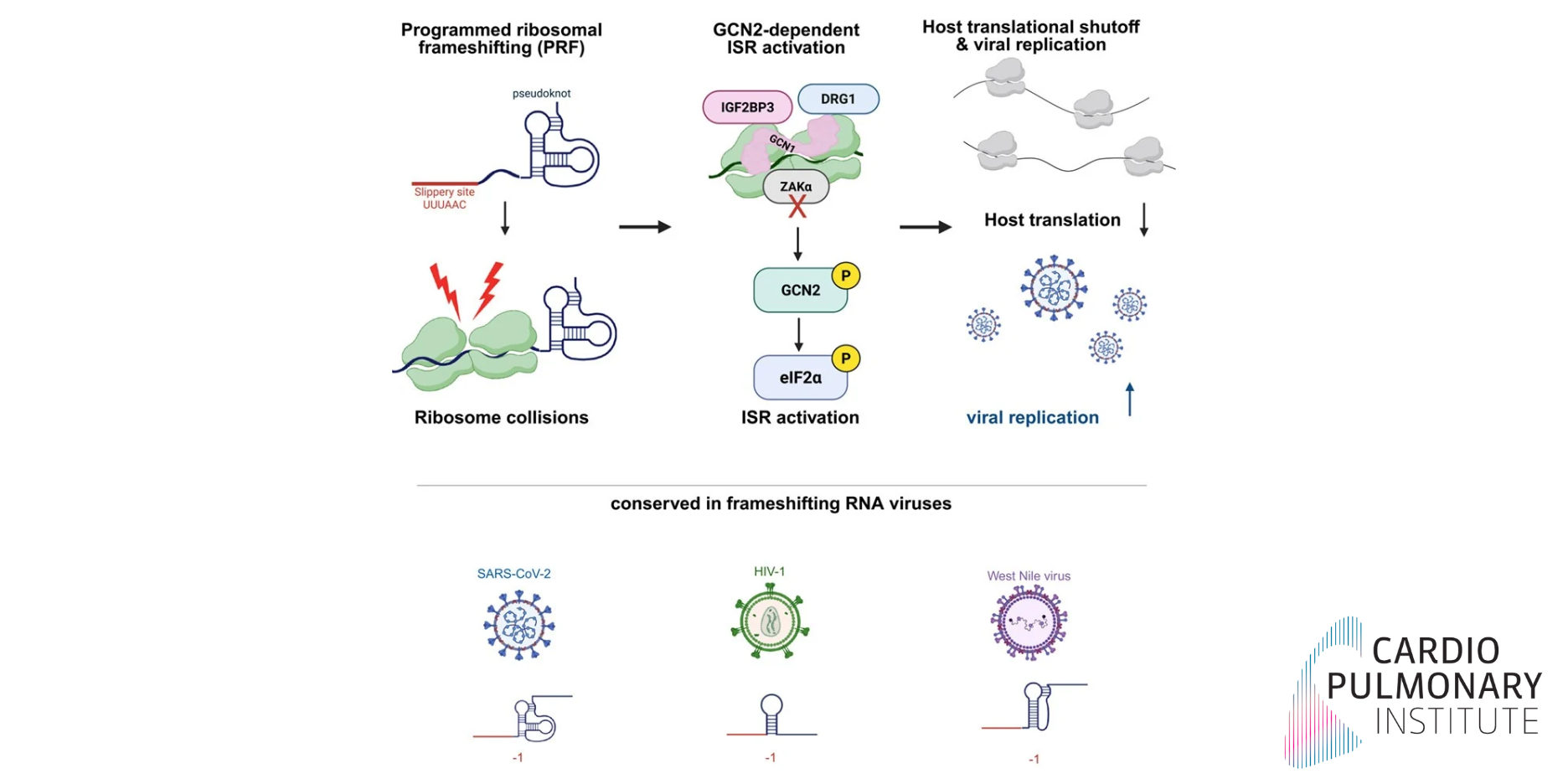
Programmed ribosomal frameshifting (PRF) is a conserved viral strategy for expressing polyproteins from compact genomes. Although PRF is traditionally viewed as a structural mechanism, the study shows that it functions as a regulatory signal that rewires host translation in favor of viral replication.
A minimal SARS-CoV-2 PRF element is sufficient to activate the GCN2 arm of the integrated stress response (ISR) independently of the canonical ISR sensor ZAKα. This activation serves as a temporal switch during early infection to shut off host translation and is required for viral propagation in cells and human airway organoids.
Proteomic and genetic screens identify DRG1 and IGF2BP3 as key mediators of PRF-induced GCN2 activation. The authors further show that this PRF-GCN2 axis is conserved in HIV-1 and West Nile virus, highlighting its broad relevance across RNA viruses.
These findings reveal a sophisticated mechanism of viral translational control, highlighting PRF as a stress-inducing module that enhances viral replication.
Congratulations to all authors and collaborators!
📄 Read the paper HERE.
You need to load content from hCaptcha to submit the form. Please note that doing so will share data with third-party providers.
More InformationYou need to load content from reCAPTCHA to submit the form. Please note that doing so will share data with third-party providers.
More InformationYou need to load content from reCAPTCHA to submit the form. Please note that doing so will share data with third-party providers.
More InformationYou need to load content from reCAPTCHA to submit the form. Please note that doing so will share data with third-party providers.
More InformationYou need to load content from Turnstile to submit the form. Please note that doing so will share data with third-party providers.
More Information